Showing posts with label the writer's journey. Show all posts

Saturday, December 9, 2017

A Reflection on Sentimentality


This post was inspired by this one.
The Book of Life defines “sentimentality” as a view of life with the dark parts erased. When we look back at the past through sentimental eyes, we long for a simpler, happier time—one so very different from our present circumstances. Yet this longing, according to The Book of Life, breeds cynicism. We get caught up in our fantasy of how things used to be and ignore the reality that things weren’t always so good. We also look for the worst in the present day.
I couldn’t help wondering if this is how many Conservatives view the world—especially those who voted for and still support Donald Trump. To them, he is a throwback to a simpler time when boys could be boys and it was easy to tell who America’s enemies were: They looked different, dressed differently, and held to a different religion. Some Conservatives (I hate to make broad, general statements) want to return to this simpler time. Certain relatives of mine, who self-identified as Conservatives or Republicans, saw the world as getting much worse as it moves forward with gay rights, lack of prayer in public schools, and apparent disrespect of the American flag. In their youth, no one questioned these matters. Now everyone questions everything. Questions are scary. Questions undermine the certainty that God is on our side, or we are on his. (God is always a “he.”) They destroy the cherished illusions we take for granted: American superiority, Christian rightness, and male dominion.
However, this post is not about Conservatives. It is about me and my own brushes with sentimentality.
One of the recurring themes and preoccupations of my life is self-improvement. I know from first-hand experience that I can be wrong and usually am. So, any faith I had in American superiority, Christian rightness, and male dominion (because I am all these things—American, Christian, and male) was destroyed long ago. “Destroyed” perhaps isn’t the right word. Those thoughts are still with me. I am a product of the culture in which I was raised, and any culture has both a positive and a negative side. (Take that, sentimentality.) I also long for a past in which things were somehow “better” than they are now. I particularly feel this way when I miss certain relatives who have died and friends who have moved on. I imagine the conversations we should have had but didn’t, conversations which we made a silent pact not to have because their Truths were not my Truth, and a steady peace was preferred to the risk of all-out war of Truths. My attempts to be understood failed. My attempts to understand failed even worse.
Sentimentality seduces. A couple of years ago, I was delighted when a local radio station began playing American Top 40 programs from the ‘70s, the era of my childhood. At last, I was able to listen to all the programs I missed because I didn’t discover AT40 until I was 15. I was able to watch the classic artists and songs of my youth move up and down the chart, and to listen to host Casey Kasem’s anecdotes and chart trivia. Every Sunday I took notes and shared them on Facebook. A few of my FB friends even commented. Sentimentality is always best when shared.
Yet a certain boredom crept in. After a while, I realized there was nothing “classic” or transcendent about listening to the countdown year after year. The same artists released new songs every year, and while some were indeed memorable hits, others were just dreck. Rock ‘n’ roll, like any business, thrives on pushing product, no matter how lame, to the public. This interpretation is subjective, of course—every song is probably someone’s favorite. But even favorite status depends on where we were, who we were, who we were with, and countless other subjective associations. Most Top 40 music was bland and formulaic in the ‘70s, just as it was in the ‘80s, when I listened faithfully every week, hoping my own favorite songs and artists would rise to the top. Instead, I had to patiently wait out the reigns of “Endless Love” and Daryl Hall and John Oates. In hindsight, I appreciate the craft that went into such songs and artists. At the time, I longed for an imagined past of the ‘70s when the likes of Led Zeppelin, Deep Purple, and Grand Funk reigned supreme.
Sentimentality runs its course—or it should. There should come a point where we realize we are learning nothing new and that the very feelings we are trying to avoid—uncertainty, anxiety, nervousness—point to impending change. The world evolves constantly, and we can either embrace those changes or turn back to an imagined past where things were better, happier. I suggest it’s not bad if we do this occasionally. Looking to the past can remind us who we are and where we came from. As is evident in some of my Conservative friends, tradition reaffirms values: what it means to be American or Christian or male (or female).
However, sentimentality becomes a trap when we refuse to see it for what it is, when we take the fantasy as real and become bitter towards a present which doesn’t live up to our expectations. The simple truth is that the past wasn’t always so great. The ‘70s I grew up in were full of personal upheavals. About a year ago, I found my old school records. I passed many of my classes only because my mother implored my teachers and principals to let me pass. I was so traumatized by being picked on and bullied that I couldn’t concentrate on school work. In the eighth grade, I stopped going to school yet somehow managed to pass. In the ninth grade, a teacher came to my house to deliver and collect assignments. Then I switched schools—to a Conservative, religious school which proclaimed rock ‘n’ roll to be the devil’s music. Of course, this was the time when I got into rock ‘n’ roll. My identity was formed in part by rebellion against what I saw as the narrow-mindedness of the people on whom I depended for life and education.
The sentimentality of my youth would have required me to be born about 20 years earlier so I could have been part of that generation which changed the music world—the Beatles, the Stones, and my go-to group, Jefferson Airplane/Jefferson Starship. Many of these artists were still active in the ‘70s and ‘80s. They had “made it.” I, too, wanted to make it without having to go through adolescence and young adulthood and college and figuring out what I wanted to do. I imagined they lived happy lives as established artists whose records were all but guaranteed to be successful and whose every pronouncement made the news with Messianic weight. And they were all a “family”—creative and loved.
Of course, I know differently now. My curiosity about such artists led me to research them and learn their Truths: the addictions, the pressure to have hits, the tension between remaining original yet pleasing the crowds, the broken relationships, the massive egos. Yet in studying their Truths, I learned to let go of my own fantasies and to open myself to the wonder of reality: the miracle of what it is truly like to create something which impacts others. I also learned, in a roundabout way, to understand and embrace my own Truth.

The Book of Life has it right: Sentimentality can breed cynicism, but only if we let it. If we recognize sentimentality for what it is—a temporary excursion into how we want things to be—we can use it to create a better future.

Photo: https://openclipart.org/detail/277056/sad-lady-and-kids

Saturday, July 22, 2017

One Writer’s Journey: Writing and the Intersection of Everything


            One of my college professors gave me a strange piece of advice: If I wanted to be a professional writer, he cautioned me, I should study something other than writing. His reasoning: Writers need something (other than writing) to write about, and too much focus on one thing can lead to a myopic view of the world.
            At the time, I thought such advice was mad. I wanted to write comic books for a living; why did I need to study anything else? However, I kept his words in the back of my mind even as I went on to devote most of my studies to writing—majoring in English, completing a master’s in English, attending numerous workshops and conferences.
In time, I began to understand what he meant: Writing can be an insular world. Writers spend all day inside their own heads. They hang out with other writers, talk about writing, and perpetuate the sense the writing is the center of our universe—almost our god.
***
            However, a singular focus on the craft of writing isn’t necessarily bad. When I was young, I watched adults around me struggle through jobs they hated. I decided I didn’t want that. I never wanted to take a job or choose a career just to earn a paycheck. Money alone has never been sufficient motivation for me to do anything (though lack of money has been). 
            I chose a different path by focusing on things which interested me, things I enjoyed doing, and things which challenged me intellectually and emotionally. I found all of these things in writing—and it happened almost by accident.
***
            I grew up reading comic books and watching science fiction shows such as Star Trek. They sparked my imagination by showing me possibilities that didn’t exist in the so-called real world. I wanted to be a super-hero or a Starfleet officer! Since those careers did not exist, I turned to the creative process behind such characters.
            Like most kids, I first wanted to be an artist. Armed with only a pencil, typing paper, and markers, I got pretty good at copying the line work, figures, and shading of certain comic book artists (Neal Adams, Dave Cockrum, and John and Sal Buscema were favorites) and created my own characters. But when it came to studying art in school, something didn’t click. Learning to draw fruit, the folds in clothing, and the same figure doing different things (smiling, dancing, running), was too much like work. I wanted to do something fun.
***
            Learning the craft of writing hasn’t been fun (at least as I defined the term then), but it has engaged me in wholly different ways. I love the structure of writing—how an outline can lead to the basic building blocks of a story yet leave room for improvisation. I love the way writing looks on a page or screen—neat and ordered formats remove all doubt as to where to put the page number and allow me to concentrate on the most important thing in writing: ideas.
I also became enthralled with writing scripts. I write something down, and a character in a story says it. I describe a scene, and an artist brings it to life.
Early collaborations, however, did not go well. As I wrote numerous scripts which will never be drawn, I became aware of my own limitations as writer. I created a Star Trek-like military, but had little clue what being in the military was actually like. (Fortunately, my brother and father both served, so I learned somewhat from their experiences.) I cleverly called my science officer a “geometeorologist,” but had no idea what a geologist or a meteorologist would do in the context of an alien planet, let alone someone who combined both fields.
Writing super-heroes seemed easier because I could just make stuff up, but even then I had no idea how to pace or end a story. I was further dismayed when people read my scripts and told me all my characters sounded alike!
Clearly, I was missing something.
One thing I've learned from my journey is that writing does indeed go hand in hand with other things--with everything, in fact. Garrison Keillor said it best and with his usual wit: "Nothing bad happens to writers. Everything is material." Everything. 
My professor was partially correct: If you want to write, study writing, but also study everything else: politics, religion, philosophy, human behavior, geology, biology, history...everything informs your world and the worlds you create.


Art credit: https://openclipart.org/detail/277036/ink-muse

Sunday, June 23, 2013

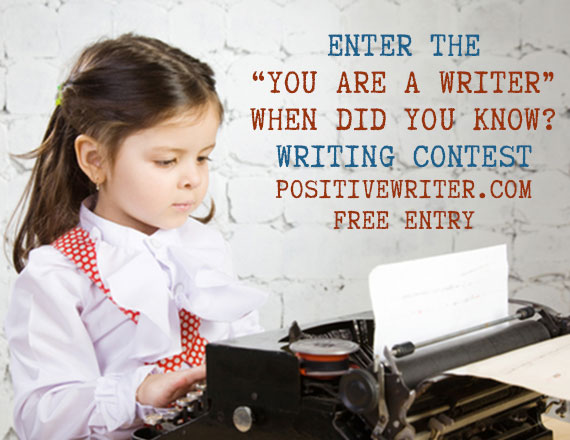
When Did You Know You Were a Writer?


PW-you-are-a-writer-writing-contest
Image borrowed with permission from The Positive Writer.

 
I’m participating in the “You Are a Writer—When Did You Know?” contest on The Positive Writer.   

Here goes . . .

I'm a non-conformist by nature. I hate playing games that are rigged for the other side to win, no matter how much the other side tells me it’s my duty to play, no matter how much they tell me I’d better fall in line or something bad will happen. I particularly don’t like rigged games where the winners take advantage of other players.

So when I was 12, I saw a news story about Jerry Siegel and Joe Shuster, then middle-aged men, who were teenagers when they created Superman. They sold their creation to what became DC Comics, which went on to reap millions from Superman comics, movies, and merchandise. Meanwhile, Siegel and Shuster spent decades fighting to get credit and a pension.

In the decades since then, I've learned their story is more complicated than that, and that it's easy to paint the Evil Corporation as a predator gobbling up the works of poor, unsuspecting writers and artists (which, often, corporations do).

At the time, however, their story filled me with two contradictory but irresistible notions: one, the realization that people actually created comic book characters and got paid to do so, and, two, a sympathetic bond with Siegel and Shuster, who were not much older than I was when they conceived the character who would revolutionize the comics industry and inspire generations of young readers. Being 12, I thought I could do the same thing only better. I would not get ripped off. I would create a new character who would make me fabulously wealthy.

I returned to that dream time and time again as I encountered other games that appeared rigged: high school, employment, even my first forays into college. Every path in life, it seemed, required hard work but few rewards for those who did the actual work. There had to be another way.

Comics, though produced by a rigged system (the comics industry), yielded hope. They were a fringe obsession—not as popular or widely accepted as sports, films, and even literature. To enter those occupations, you had to be accepted into a rigged system. The comics industry was small enough that it resembled rock ‘n’ roll in the early days: any kid could pick up a pencil or typewriter and start creating comics. Any kid could afford to dream big.

Then reality set in. I wrote scripts, sent them to publishers, got rejected, and was “encouraged” to continue my education. So I wound up back in college, where grants and student assistance programs showed me that even a "rigged" system sometimes wanted new entrants to succeed, and where encouraging professors taught me I didn’t have to abandon my weird interests. I just had to reach deeper and see the connections between super-heroes and other things: mythology, fables, legends and stories of all kinds.  

Yes, Virginia, there is a reason why you should hang on to childhood notions.

Writing bridges the gap between individuality and conformity. Writing enables me to express myself and to connect with others. Writing requires a great deal of conformity—grammar, usage, audience, purpose—but provides clear reasons and benefits for doing so (e.g., getting your message across in the most effective way possible). 

Writing also bridges the gap between rigged systems and individual paths to success. Nowhere is this more evident than in modern publishing. Many writers, burned or rejected by traditional publishers, have found ways to get their work before an audience through self-publishing. Writers have mastered the tools of the rigged game and turned those tools to their advantage.

Writing is simultaneously subversive and conformist: It gives practitioners the tools to accomplish whatever they wish. Write a cover letter, a resume, a short story, a novel, a poem, a comic book, an argument, a thesis, an explanation, a synthesis . . . it's all there: a masterpiece of words waiting to be crafted.

And though writing may not lead to fabulous wealth and independence (though it might), it often leads to something deeper and more fulfilling: a path to self discovery.

Are you a writer?  Go to The Positive Writer's blog and enter the contest.  Then post a link to your blog in the comments below so I can read your story.

What Made the Beatles Unique? A Personal Perspective

    Photo by Fedor on Unsplash   One of the social media groups I frequent posed a thought-provoking post on the Beatles. The post was acco...