Sunday, September 1, 2013

How Do You Deal with Your Writing’s Growing Pains?


Writing can be like unruly children. Just when you think they're ready to grow up and do you proud, they throw fits, stop cooperating, and make you wonder why you wanted to have kids in the first place.

So you have a book or two (or three or four) under your belt. You have your writing process down pat.  You’ve mastered the art of fiction and the science of winning over audiences. Through a long, painstaking process of trial and error, you’ve devised a formula for success and it works every time.

And then it doesn’t.

The new work in progress doesn’t quite gell. After writing twenty thousand words, you realize you don’t know the characters well enough to know what they want. The complicated back story fascinates you more than what they are doing now. Your beta readers complain that this story reads just like your last, or it reads like an outline. Or both.

You, my writer friend, are experiencing growing pains.

Or, to be more precise, your writing is. 

Writing, like a child, grows in fits and starts. It constantly tests its boundaries. It seems happy one minute and hysterical the next. It is no longer pacified by the routine that worked last year. And, like any beleaguered parent, you can’t understand what to do with your six-year-old who has overnight turned 15.

Growing pains are uncomfortable and scary for writers. They force us out of our comfort zones and into unknown territory. They cause us to question everything we do and everything we’ve done. 

They may even force us to reevaluate why we wanted to be writers in the first place. Where’s that untold wealth and fame we’re supposed to get? Why isn’t writing getting easier? 

Does parenting ever get easier?

Yet growing pains can be positive and necessary for writers. They could be a way for our subconscious minds to point out things to us we don’t want to face. Maybe they are calling attention to areas in our writing or our lives (which often are intertwined) that need more attention. Maybe they're trying to tell us we’ve crossed one bridge and it’s time to do something new.

While we try to figure out what our unruly writing-child is telling us, here are three tips for dealing with growing pains:
·        

  •  Take a break.  Stepping away from writing for awhile may be the best thing.  We all need a time out to gain a new perspective.  The catch, though, is that you must come back to writing at some point.  Giving yourself a vacation from writing may be all you need to come back to it fresh.

  • Write something else.  If you’ve worked hard at building your brand in a specific genre or with a certain cast of characters, there’s a tendency to think that’s all you can or should write.  But forcing yourself to write the same kind of stories over and over is like forcing your kids to eat only  meat.  Without veggies, fruit, bread, and desert, they will become surly, lose focus, and unhealthy.  Writing something else helps you grow as a writer and bring something new back to your main project.


Whatever you do, don’t give up.  

How do you deal with your writing’s growing pains?  Share your tips below.

Enhanced by Zemanta

Saturday, August 24, 2013

Let Your Characters Control Your Plot (Instead of the Other Way Around)


Last week, we talked about the pratfalls of forcing your characters to serve the needs of the plot. I used a classic Legion of Super-Heroes story from Adventure Comics to demonstrate how writers can unintentionally make their characters act like puppets in order to do what the plot requires them to do.

This time, we’ll look at a different Adventure story to illustrate how plot should flow from the characters instead of the other way around. This story gets the balance between character and plot just right.

“The Legionnaire Who Killed” (Adventure Comics # 342, March 1966)

Spoiler warning: The rest of this post discusses plot elements of the story in question. Read at your own risk.

Arguably one of the most famous Legion stories of all time, “The Legionnaire Who Killed” had lasting repercussions for the titular characters for decades to come. It is also one of the last Legion stories written by Edmond Hamilton, a noted science fiction author who had been one of the Legion’s two regular writers (the other being Jerry Siegel) during its formative years.

Copr. and TM DC Comics Inc.
Hamilton’s stories represent both the best and worst of the Silver Age DC Comics. His fertile imagination produced some of the most memorable Legionnaires, planets, and technology, yet his wildly implausible plots and characters often seemed silly even by 1960s comic book standards.   

In “The Legionnaire Who Killed,” however, Hamilton crafts a story that honors his characters as individuals, respects the difficult situation they find themselves in, and trusts the readers to embrace an ending that does not turn out the way we hope.

The story centers on Star Boy (Thom Kallor), a Legionnaire known for his purple and white costume, crew cut, and power to make objects super-heavy.

Feeling lonely because the girl he likes, one-time Legionnaire Dream Girl, is far away, Star Boy takes a leave of absence to visit his parents on a distant jungle world. Arriving just after they’ve left, Star Boy is confronted by Kenz Nuhor, a baddie whose advances Dream Girl has spurned because she’s in love with Star Boy. Like a typical psychopath, Nuhor decides the way to win Dream Girl’s heart is to kill his rival.

Star Boy, his power useless against Nuhor’s special shield, does what any clear-thinking individual would do under the circumstances: He picks up a gun dropped by a hunter Nuhor has killed and shoots the villain dead.

The problem? Killing is against the Legion’s code.

Thom's Legion buddies haul his butt before a court martial.  During the trial, several significant issues are raised: Did Star Boy break the Legion’s code even though he acted in self defense? Could he have stopped Nuhor without killing him? Should Legionnaires have the right to kill in self defense?

While the Legionnaires grapple with these issues and Thom’s fate, they behave in manners which are wholly appropriate to their characters. Their actions, in turn, drive the plot:

  • Brainiac 5, serving as prosecutor, “proves” that Thom could have disabled Nuhor by making a thick tree limb above Nuhor’s head heavy enough to fall on top of the villain. (Never mind that doing so might have broken the villain’s neck, leaving Star Boy in the same fix he’s in. The prosecutor’s role is only to create an element of doubt, and Brainy—cold and composed—does so in a manner that would make Jack McCoy proud.) Brainiac 5 serves as the story’s antagonist by continually thwarting the hero’s desire (to be acquitted).

  • Superboy, serving as defense attorney, goes to great and sometimes questionable lengths to get his client off. He stages a mock attack with a dangerous beast to trick other Legionnaires into trying to kill the beast. He turns the tables on Brainiac 5 by accusing the latter of having previously killed a foe. Superboy’s efforts fail because, in both cases, he has not done enough research. However, his failures keep the plot moving forward and heighten the tension.

  • Star Boy, once the trial begins, can do nothing but sit tight in the Legion’s holding cell and express his faith in Superboy’s defense. But even here Star Boy remains our protagonist—the one we care about and sympathize with. We know he “broke the law,” even though we understand why he did so, and we want him to win even though we know there must be consequences for his actions.

  • Dream Girl is more than a love interest here. Although she starts the story as a MacGuffin, she plays a crucial role in supporting Star Boy and adding tension when the latter suspects her ability to predict the future has foretold that he will lose the case. (In a brilliant bit of story telling, we’re never told if she has foreseen the outcome of the trial or not; this is left to our interpretation.) Dream Girl also plays a significant role in the ending by turning the tragic outcome of the trial into a positive for Star Boy: she convinces the Legion of Substitute-Heroes to take them both on as members.

The main characters’ actions spring logically from the situations they find themselves in. Their reactions, in turn, drive the plot and bring it to a satisfying conclusion.

The lessons for us as writers are four fold:

1. Know your characters well enough to anticipate how they will react in any given situation.

We care about Star Boy because Hamilton spends some time letting us get to know him. He misses his girl. He wants to visit his parents. He finds himself in an impossible situation and must act. Star Boy comes off as Joe Average, someone anyone can identify with.

2.  Let your characters’ actions and reactions drive the needs of the plot.

If you’ve done No. 1 well, No. 2 will almost write itself. Your characters will be strong and proactive but also human. Their human weaknesses will keep the plot moving forward. (If Star Boy hadn’t overlooked the tree limb, there might be no story. If Superboy had done his research, the trial would be over too quickly.)

3. Give your characters reasonable but competing goals.

Though he’s the antagonist, Brainiac 5 is not the villain. He wants what every Legionnaire wants—what’s best for the Legion. But his goal is to uphold the Legion’s code as it exists—this means Star Boy has to go. Star Boy’s goal, obviously, is to be exonerated and stay with the Legion. Their competing goals create the story’s conflict.

4.  Let your story resolve itself into its inevitable conclusion.

This can be a tough one because sometimes the ending we want to write (or the ending the audience expects) isn’t what the story needs. It was risky for Hamilton to expel a Legionnaire—particularly one he’s spent so much time making us care about—but that’s what makes this story memorable. If Star Boy had been acquitted, it would have been business as usual. 

A story should never be business as usual.

Letting your characters control the plot instead of the other way around keeps them from acting like puppets. More, readers might just remember your story for years and even decades to come.


Enhanced by Zemanta

Sunday, August 18, 2013

Do Your Characters Act Like Puppets?


My pleasure reading these days includes old Legion of Super-Heroes stories and reviewing them for the Legion World message board. It’s always risky to go back and re-read stories you grew up on.  They may not live up to the hype imposed by memory and childhood wonder.  

However, revisiting old stories can also produce insights for writers. We can learn from the choices previous writers made, both good and bad.

Two recent re-reads, for example, helped clarify in my mind the relationship between character and plot—specifically why plot should emerge from the characters instead of the other way around. 

In looking at these two stories, we can get a sense of how not to treat our characters like puppets of the plot.

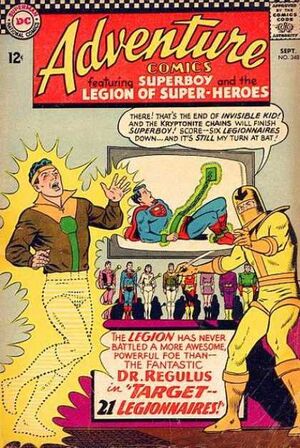
“Target—21 Legionnaires” (Adventure Comics # 348, September 1966)

This story was written by Jim Shooter, who made comics history when he became the regular Legion writer at the age of 14. Shooter was roughly the same age as the Legionnaires he wrote and so he was able to bring a lot of realism to their personalities and dialogue. Shooter also created many of the Legion’s most memorable villains, including, in this issue, Dr. Regulus.

However, Shooter was still developing as a writer, and that explains why certain actions in this story are not wholly believable.

Dr. Regulus, a disgraced scientist who harnesses the power of gold, holds a vendetta against a particular Legionnaire, Sun Boy, and arranges for the latter to suffer from amnesia while Regulus steals the Legion’s clubhouse headquarters. However, the other Legionnaires track Regulus down and board his massive ship. 

Here’s where the plot forces the characters to do a puppet-like dance.

Cover for Adventure Comics #348 (1966)
Copr. and TM DC Comics Inc.
As the Legionnaires separate to explore the ship, Colossal Boy enters a room that is tailor made for him—it’s giant-sized.  It also contains a giant robot that dukes it out with Colossal Boy and ultimately overpowers him.

But what if Colossal Boy had entered some other room? Are we to believe every room on the ship is giant-sized just to trap him? What if Colossal Boy hadn’t been part of the Legion team that went after Regulus?  The latter would have gone to all that planning for nothing.

A few pages later, Cosmic Boy, whose power is magnetism, becomes distracted by a noise and backs into a wall. Bad move, Cos. Gold bands emerge from the wall and ensnare him, his power useless against gold. 

What if Cos had backed against a different wall (we’re not shown similar traps on other walls) or hadn’t touched a wall at all? 

Meanwhile, the amnesiac Sun Boy wanders into a nuclear power plant, where he falls asleep. Not to worry, though. Atomic radiation (the source of his solar powers) restores his memory—and just in time, too, for he’s able to come to the rescue of his teammates aboard the ship.

I’m willing to grant the comic book logic that atomic radiation can restore the memory of a character whose power was created by atomic radiation. But I find it less plausible that, of all the places Sun Boy could have snoozed, he happened to find an unguarded nuclear power plant with an energy source that has been carelessly left open.

There are more examples of coincidence ruling the plot. And it’s a shame because “Target—21 Legionnaires” is an otherwise exciting story with several positive qualities (the realistic dialogue and personalities of the Legionnaires and a formidable villain being at the top of the list).

But because Shooter needed certain things to happen in the story—the Legionnaires get captured, Sun Boy arrives to save the day—he has the characters do things that fit the needs of the plot rather than behaving in credible ways. 

Perhaps we should give Shooter a pass for being so young when he wrote the story (and, indeed, his talents as a writer are well evident here); however, Shooter had an adult editor, Mort Weisinger, who should have known better.

In my next post, we’ll talk about the other story, published a mere few months earlier, in which the writer gets the balance between character and plot just right.

Sunday, August 11, 2013

5 Reasons Why You Should Attend the First Power Club Book Signing


Okay, so you’ve published your book. It's available in both download and paperback formats. What’s next?

The next step: Do a book signing.

You can arrange to do a book signing with bookstores that are interested in carrying your book, and, more, you should do a book signing with them. The hard truth is that nobody’s going to buy your book just because it sits on a shelf. Doing author events is a way to meet your intended audience and show them you are a real human being, someone who wrote a book with them in mind.

So I’m pleased to announce the very first Power Club™  book signing will be 1-3 p.m. Saturday, August 17, at Shawnee Books & Toys, 7311 Quivera Rd., Shawnee, KS 66216.


If you live in the Kansas City area, here are five reasons why you should attend:


  1. Shawnee Books & Toys is easy to find. This family friendly bookstore hosts weekly author or book events; I’ve attended a few, and there’s always a crowd.  
  2. As mentioned above, it will be my first solo booksigning ever. I’ve done a few author events with fellow members of the Monday Night Writers Group, but this will be the first that rests entirely on me and The Power Club. If you are an author, you can see how a book signing is done (or snicker if I screw something up); if you're a reader, you can support a local author.
  3. August 17 was my father’s birthday. Though he didn’t live to see me publish a book, I can’t help feeling the date is more than coincidence. Family, after all, is an important aspect of the book.
  4. Excerpts from the book will be read. I may even let you pick a page to be read.
  5. But the most important reason: A drawing will be held for readers 12-18 to get a free, signed copy of the book.

So, if you’ve already read the book, come out and cheer me on. If you haven’t read it, this may be your chance to get one for free.

See you there!

What Made the Beatles Unique? A Personal Perspective

    Photo by Fedor on Unsplash   One of the social media groups I frequent posed a thought-provoking post on the Beatles. The post was acco...